
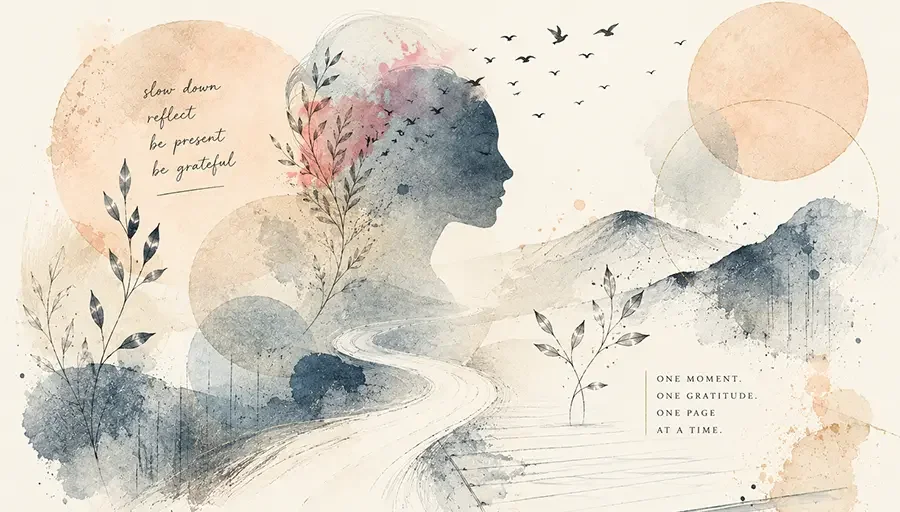
Every few years, a trend emerges that seems to contradict the direction of modern life.
At a time when artificial intelligence can generate essays, answer questions, and create images in seconds, people are buying notebooks.
At a time when our phones can capture every thought, reminder, and memory, people are picking up pens.
At a time when nearly every aspect of life is becoming more digital, more automated, and more connected, search interest in journaling, junk journals, DIY journal kits, handwriting, paper planners, and analog hobbies continues to grow.
At first glance, it doesn't make much sense.
Why would people move backward when technology keeps moving forward?
The answer, I believe, is that they aren't moving backward at all.
They're trying to recover something they've lost.
The Quiet Cost of a Life Spent Consuming
Most of us spend our days surrounded by information.
We wake up and check our phones. We scroll through headlines, messages, social feeds, and notifications. Throughout the day we consume emails, videos, articles, podcasts, advertisements, opinions, and recommendations. Then we finish the evening much the same way we started it, looking at another screen.
None of this is inherently bad. Modern technology has improved our lives in remarkable ways.
But there is a difference between being informed and being consumed.
Many of us have become extraordinarily good at taking things in while becoming increasingly disconnected from what is happening within us. We know what everyone else thinks. We know what everyone else is doing. We know what everyone else is arguing about.
Yet we rarely sit with our own thoughts long enough to understand them.
This may explain why so many people are returning to practices that seem almost old-fashioned.
Journaling is not merely about recording thoughts.
It is about creating space for them.
Why Journaling Feels Different
A journal asks something that few modern technologies ask of us.
It asks us to participate.
There is no algorithm telling us what to think. No notifications interrupting our attention. No endless stream of content competing for our focus.
There is only a blank page.
That blank page can feel intimidating at first. But it also offers something increasingly rare: freedom.
The freedom to slow down.
The freedom to reflect.
The freedom to notice.
Research suggests that writing by hand engages the brain differently than typing. Handwriting requires more deliberate movement and deeper cognitive processing. Because it is slower, it naturally encourages reflection.
That slower pace may be one reason journaling continues to resonate despite the endless digital alternatives available to us.
Writing by hand creates a pause.
And often, meaningful change begins with a pause.
Why So Many Gratitude Journals Fail
The popularity of gratitude journaling has grown dramatically over the last decade. Research has connected gratitude practices with improved wellbeing, stronger relationships, greater resilience, and increased optimism.
Yet many people start gratitude journals and quietly abandon them a few weeks later.
The reason is often surprisingly simple.
Many gratitude journals turn gratitude into a checklist.
Write three things.
Write five things.
Write ten things.
At first, the exercise feels productive. Over time, however, the entries often become repetitive.
Coffee.
Family.
Friends.
Nice weather.
The problem isn't gratitude.
The problem is that the practice can become mechanical.
When gratitude becomes another task to complete, it loses much of its power.
People stop reflecting and start listing.
The journal becomes another obligation.
Eventually, it gets left on a shelf.
The Power of One Meaningful Gratitude
What if the goal isn't to notice more things?
What if the goal is to notice things more deeply?
Instead of writing multiple gratitudes every day, imagine reflecting on just one.
One meaningful moment.
One interaction.
One observation.
One act of kindness.
One experience that deserves your attention.
The question shifts from "What am I grateful for?" to something much more interesting:
"Why did this moment matter?"
That small shift changes everything.
Instead of collecting items, we begin exploring experiences.
Instead of documenting life, we begin paying attention to it.
This is where gratitude becomes less about positive thinking and more about awareness.
And awareness has a way of changing how we experience the world.
The Rise of Journaling Is Really About Creation
The resurgence of journaling isn't happening in isolation.
It exists alongside growing interest in junk journals, DIY projects, scrapbooking, needlepoint, handmade crafts, personalized books, and countless other analog pursuits.
The common thread is not nostalgia.
The common thread is creation.
For years, technology has made consumption easier than ever. We can spend entire days absorbing information without creating anything ourselves.
Yet human beings are not wired only to consume.
We are wired to make things.
To build.
To write.
To draw.
To imagine.
To leave fingerprints on our lives.
A journal may be one of the simplest creative tools ever invented.
Every page begins empty.
Every page becomes uniquely ours.
No two journals are ever the same because no two lives are the same.
In many ways, journaling is one of the few places where consumption ends and creation begins.
What Journaling Has to Do With Mental Wellbeing
Journaling is not a cure for anxiety, depression, grief, or life's inevitable challenges.
But it can help us develop a relationship with our experiences.
When we write, we slow down enough to observe what we are thinking and feeling. We create distance between ourselves and our reactions. We begin to identify patterns that might otherwise remain invisible.
Research on expressive writing and gratitude practices suggests that reflection can support emotional wellbeing, resilience, self-awareness, and stress management.
Perhaps most importantly, journaling reminds us that our inner lives deserve attention.
Not every problem needs to be solved immediately.
Sometimes it simply needs to be understood.
Why People Are Returning to Pen and Paper
The future will almost certainly become more digital.
Artificial intelligence will become more capable. Devices will become more integrated into our lives. Technology will continue to solve problems we haven't even imagined yet.
Yet the rise of journaling suggests that people are searching for something technology alone cannot provide.
They are searching for presence.
For reflection.
For attention.
For a way to participate in their lives rather than simply observe them.
A journal offers no notifications.
No recommendations.
No algorithm.
Only a blank page and an invitation.
An invitation to notice what matters.
To reflect on one meaningful gratitude.
To explore one meaningful thought.
To create something rather than consume something.
Perhaps that is why journaling is making a comeback.
Not because people want less technology.
Because they want more attention.
And attention, ultimately, is where gratitude begins.
One handwritten page at a time.
As journaling continues to grow in popularity, it may be worth asking whether people are really searching for a better notebook, a better prompt, or a better system. Perhaps what they are searching for is a better relationship with their own attention. In a culture that constantly encourages us to look outward, journaling offers a rare invitation to look inward. It reminds us that meaning is often found not in doing more, but in noticing more.
A single handwritten page cannot solve every problem, but it can help us slow down long enough to recognize what matters, what deserves our gratitude, and how we want to show up in the world. That simple act of paying attention may be the reason journaling continues to endure, and why it feels more relevant today than ever before.